
Two Indiana Busted Mugshot Layers
A county jail takes the photo during intake. The sheriff keeps the booking record. That file may hold the arrest details, a booking number, custody changes, and a photo, but pictures appear only when the agency releases them. Every county runs its own setup. Some point visitors to a shared portal or a vendor roster, and others offer nothing more than text. A few keep no public search at all.
The state-prison layer works differently. The Indiana Department of Correction (IDOC) keeps status and profile data for people in its custody. Its public locator is text-first, and the agency says identification photos may be released after review. So a county jail image and an IDOC identification photo are two different records held by two different offices.
Indiana Busted Booking Record Fields
No statewide booking form exists in Indiana. Each county picks its own fields. A roster may show less than the full file. Once someone is released, they drop out of a current-custody view even though the official record stays with the agency. The examples separate the county jail record from the IDOC profile, since exact fields depend on the custodian and the page.
| Field or record stage | What it may show |
|---|---|
| County booking | Name, booking or inmate ID, booking date and time, arresting agency, charges, a bond or amount field, and a booking photo when the county publishes one. Knox County's observed roster showed these fields; other counties differ. |
| IDOC profile | Name, DOC number, birth month and year, physical descriptors, facility or location, sentence and offense, committing county and cause number, possible release details, comments, and a custody-notification link. |
| Just booked or in custody | A county roster may show the person while the jail holds them. A photo may appear, a placeholder may appear, or the system may be text-only. |
| Released from county jail | The live roster may stop showing the person. Ask the county custodian for the booking file or photo. The agency's retention schedule controls the file, not the roster's visible history. |
| Sentenced to state prison | Use the IDOC locator for current state custody and its profile fields. It is not the county booking record or the case's full court history. |
A booking row lists the charge recorded at intake. That label can change before court, so the docket is the place to check.
- Booking
- The jail's intake record after an arrest.
- Arraignment
- A court hearing where the charge is read and a plea is entered.
- Bond
- A court-set amount or condition tied to release while a case is pending.
- Disposition
- The court's recorded result, such as dismissal, plea, or verdict.
- Expungement
- A legal process that changes access to or treatment of eligible records.
Note: County rosters can leave out fields that the full booking file contains, so ask the custodian for the record itself when a detail is missing.
Request Indiana Busted Booking Records
Indiana's Access to Public Records Act, IC 5-14-3, governs what public agencies hold. A photo in an agency file is not a photo the agency must post online. The Indiana Public Access Counselor says to identify the booking image and its likely custodian first. Agencies can claim lawful exceptions. Investigatory discretion is one example. Still, a mugshot is not automatically exempt just because it sits in a criminal file.
For a county record, write to the sheriff or jail that handled the booking. For IDOC records, use the department's offender-records process. Offender-specific requests go to coaoffenderrecordrequest@idoc.in.gov. Put a name or DOC number in the subject. Use Authorization of Release Form SF 46729 for a full offender record. Neither office keeps a statewide database. So don't ask either one to build what it doesn't have. Fees and turnaround times also vary by county.
- Identify the county and the agency that made or holds the record.
- Give the person's name and a useful arrest or booking date range.
- Name the exact items, such as the booking or intake photo, booking sheet, or custody record.
- Ask for electronic copies if the record is kept in that form, and request the legal basis for any denial.
- For IDOC files, use the IDOC records route and its required authorization form when the request calls for a full offender record.
County jail retention rules matter here. Indiana's county schedule allows destruction of the adult custody file ten years after incarceration ends. That schedule does not classify every booking image. Ask the custodian which record series covers your photo. The state's mugshot and sealing rules are covered in Indiana's public mugshot laws.
Note: A retention schedule permits destruction under set rules; it does not confirm that a named person's photo was kept or destroyed.
Indiana Arrest Law and Removal Questions
Indiana has no single mugshot law. No statute makes photos private, orders sheriffs to publish, or grants universal free removal. The public-record starting point is IC 5-14-3. Separate rules in IC 24-4-18 cover criminal-history providers. That chapter bars knowing publication of certain expunged, restricted, or inaccurate details. It also requires material official changes to be reflected after the statutory period. It is no instant-delete rule.
Expungement under IC 35-38-9 works differently. It can change what a court or a records provider is allowed to show. Some no-conviction outcomes get automatic relief. Others need petitions and waiting periods. Several conviction categories stay public but must be marked expunged, with the petition and order kept confidential. A corrected official record will not wipe every saved copy or search result overnight. Ask about the free correction path, verify the official docket, and never pay anyone promising guaranteed removal for a fee.
Indiana built its open-records rules into state law. The Indiana Access to Public Records Act governs what public agencies must let the public see.
Indiana Code chapter 24-4-18 contains the state's duties for defined criminal-history providers.
An arrest file and a court file differ. The docket is where a case's outcome lives, so check it there.
Indiana Retention and Old Mugshots
A roster's date range is not a retention promise. Some Indiana counties list only people in custody, some open a release window to search, and a few post no photo online at all. State retention schedules exist. Indiana's public-safety rules say how long records should be kept, but they cannot promise that a given booking photo still exists or ever reached IARA. Ask the county first. The county that made the booking file knows best. Older prison records follow a different path. The Indiana Archives and Records Administration keeps correctional collections and posts an index to them, while IDOC hands prison files to the archive ten years after a release or a death. Historical images can carry access or reproduction limits, so paying a scan fee does not buy the right to publish a picture. County jail files do not land there automatically. They stay with the county. The Mugshot Archives section spells out the archive process and the dates each collection covers.
Find Indiana Busted Mugshots
Start with place and custody stage. A statewide query cannot replace the county jail's own roster, because counties run different systems and publish different details. Left county custody already? The current roster may no longer show that booking. For a state sentence use IDOC; for a case result, check the court docket.
- Choose the Indiana county where the arrest or booking occurred.
- Open that county's official roster or jail page and search by name or date fields the site offers.
- Check any linked booking-feed or release view, and note whether it covers current custody or past bookings.
- If no photo appears, request the specific booking image from the county records custodian.
- Use IDOC only for the state-prison layer, then check MyCase for public case activity and disposition.
The Indiana County Directory routes each county to its own local records page. A roster hit reflects that system at that moment. It can lag behind a later release or transfer. Who got booked last night? That hinges on each county's posting schedule and its public-record policy. An empty search proves nothing. The person may not be entered yet, the county may publish no feed, or the search terms may simply miss the record.
Indiana Roster Search Fields
The Indiana County Jail Public Portal is one shared route, not a complete state roster. Some counties use it; many do not. Other sheriff pages and vendors run their own forms, and a county link may hand off to a vendor site, so confirm the destination through the sheriff's official page.
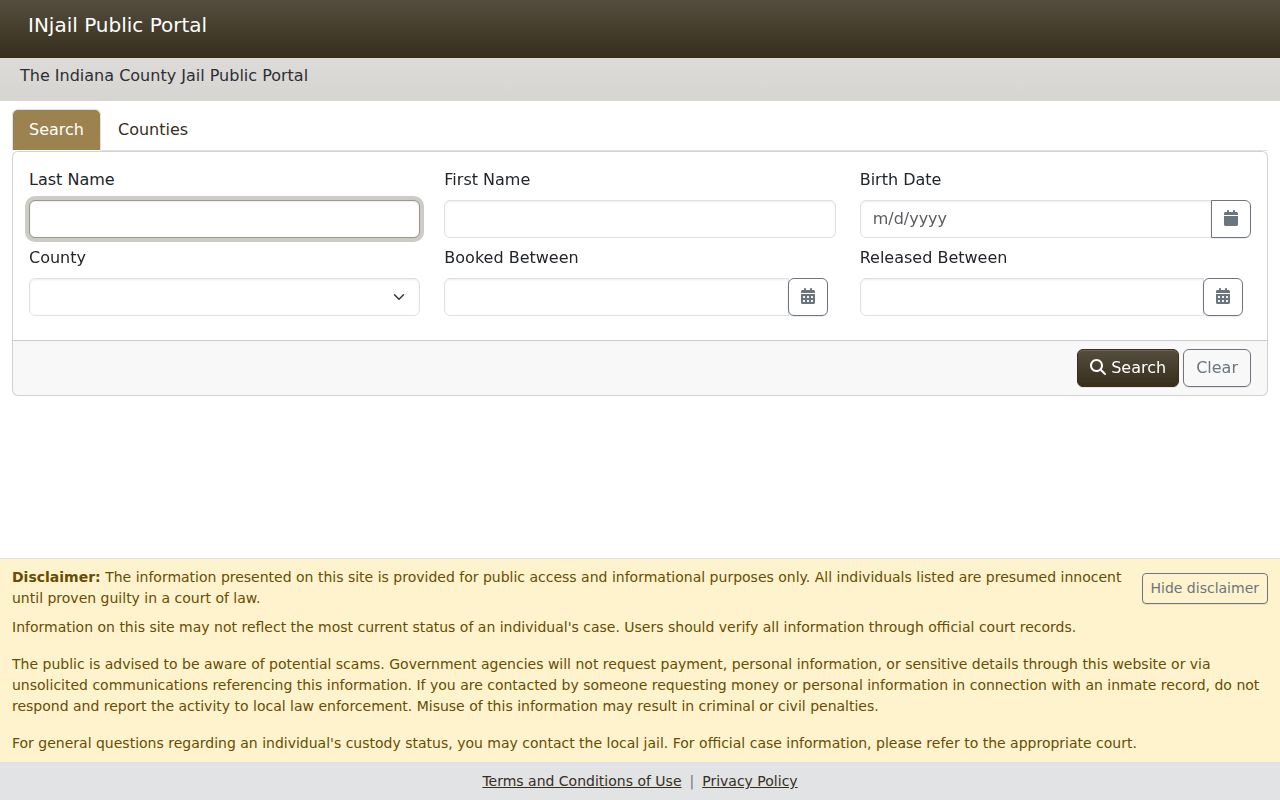
The blank INjail screen lists its shared filters. Fields include name, county, birth date, booked-between, and released-between. Date presets cover today, seven days, 30 days, the current month, and the prior month. Those are inputs only. No filter guarantees a field on every result or coverage in every Indiana county. Start narrow but not too tight. One or two solid details work best, because overly narrow filters can hide a real match.
| Search field | How it narrows a roster search |
|---|---|
| Last name | Starts a name search across the chosen portal's records. |
| First name | Can narrow results when the name is common. |
| County | Limits a shared-portal search to a participating county. |
| Birth date | Can distinguish people with similar names if known and entered as the form accepts it. |
| Booked between | Limits the search to an intake-date range. |
| Released between | May show a release-period record where that county's system includes released people. |
A blank photo box does not mean no image was made. Official systems often show a placeholder, omit pictures entirely, or push you toward a separate records request. Note: the shared portal's filters are a useful example, yet another Indiana county may run a completely different roster and search form.
A blank Indiana County Jail Public Portal search form displays the filters it supports.
Why Indiana Busted Photos Vary
Public photo practices split into four patterns. Some rosters attach a booking image to most entries. Others show a picture only when one exists and leave a blank or placeholder otherwise. Plenty of official pages give custody details with no public image at all, and some counties post no online booking roster, leaving a records request as the first reliable route.
Size predicts nothing. Marion County's public jail path is text-oriented. Boone's sheriff points visitors to an inmate lookup page. Carroll County links users to the shared INjail portal. Vigo reports that a detail page may show an intake image without promising one on every entry. Each county follows its own path, with its own limits.
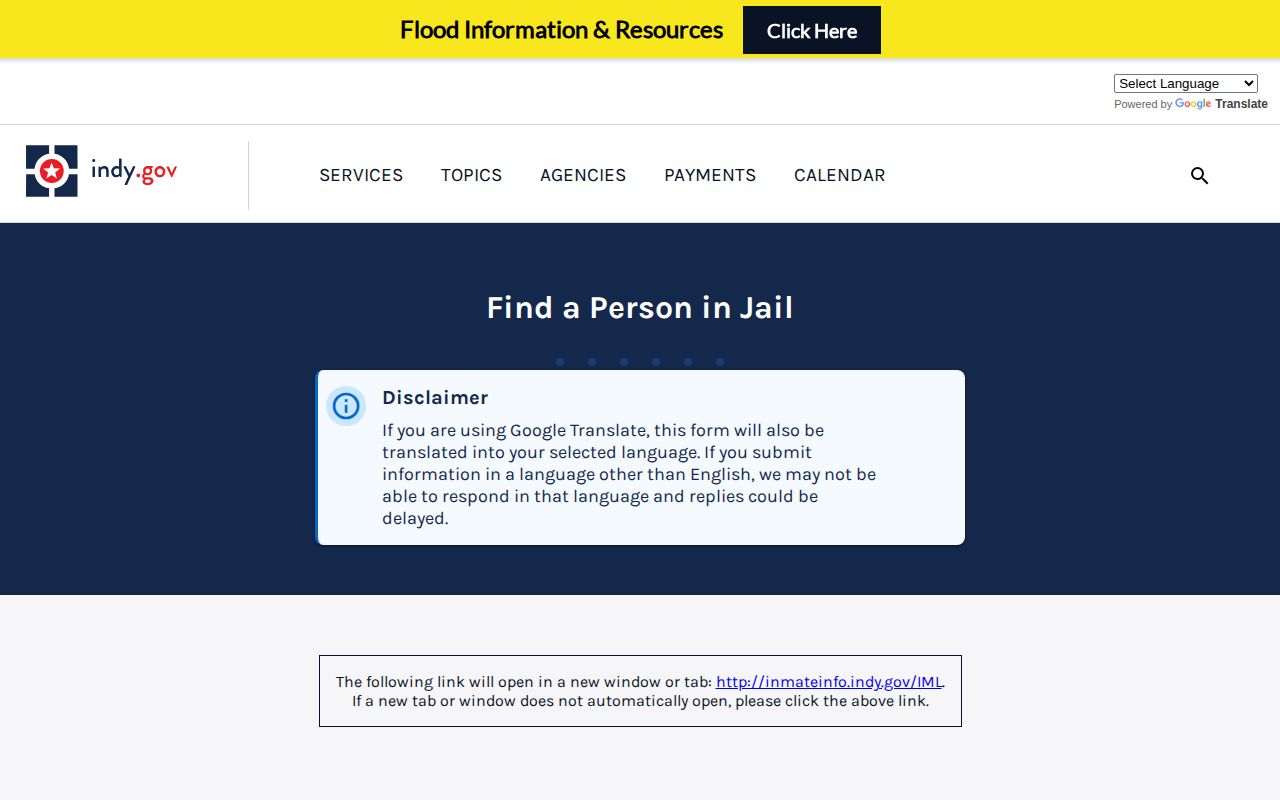
Indianapolis keeps it text-based. Its Find a Person in Jail page points to a local search path, not a statewide photo roster.
Busted in Indiana: County Roster Routes
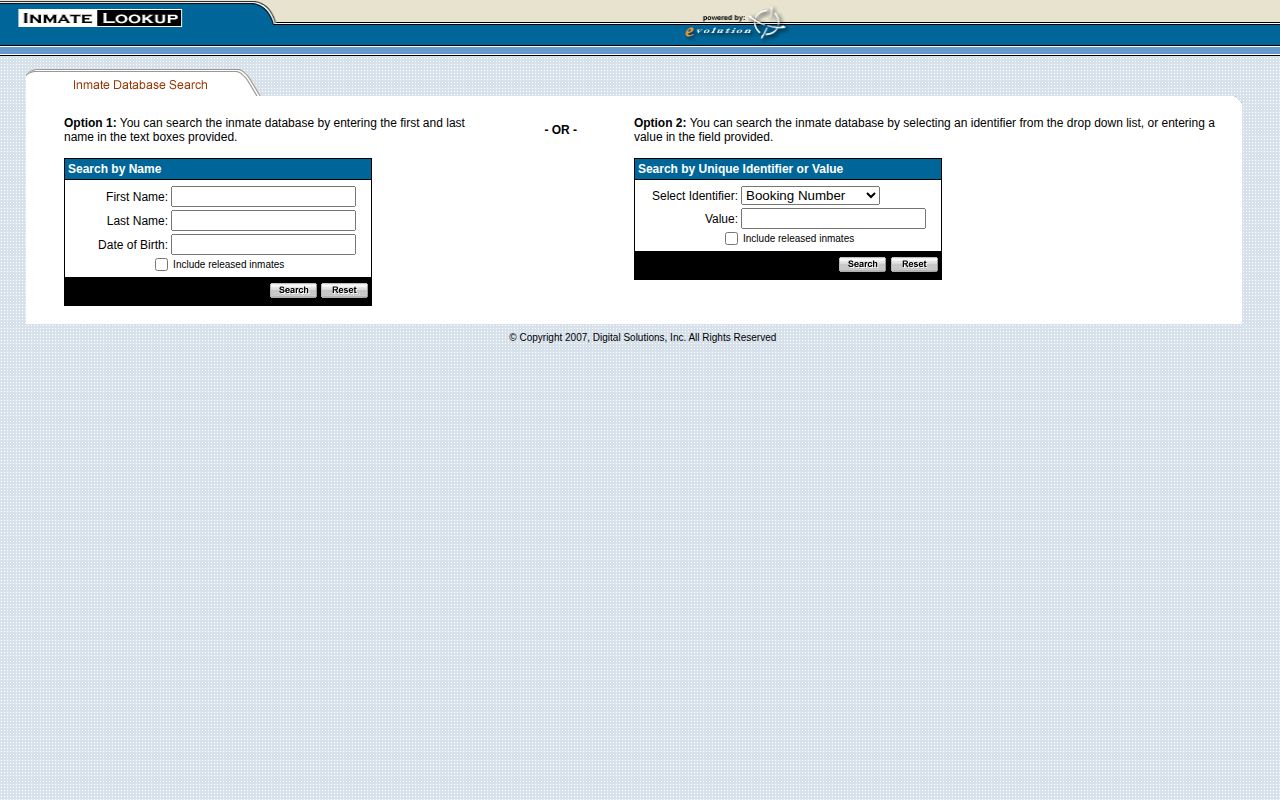
Indiana has no single booking feed. Each sheriff picks the setup: a shared portal, a vendor system, a sheriff-hosted page, or no public search at all. Vendor rosters differ too. Some allow current and released-record searches, with date windows and photo behavior set as local options. A public result can be narrower than the agency's full custody file. Marion County's inmate portal offers name and identifier searches plus an option to include released inmates. That path stays local. Its blank view shows no person results. Boone's official handoff, Knox County's hosted page, Vigo's detail views, and many other county systems all differ in what they display. Pick a county first.
The Marion County inmate portal shows its blank search fields and released-record option.
Indiana DOC Offender Photos
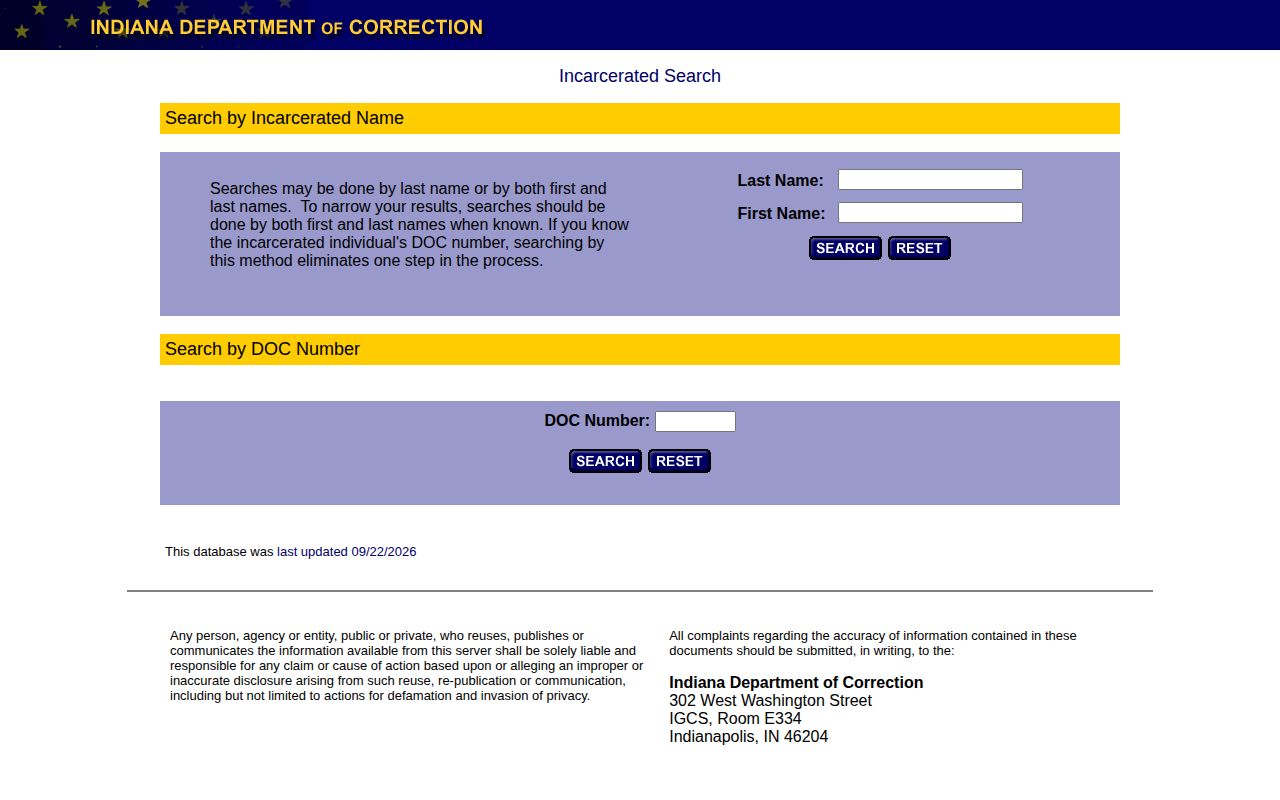
IDOC's public database for incarcerated people offers a few ways to search. You can enter a last name. A full first and last name works too, and so does a DOC number. That number field takes up to eight characters. Each result row may list the person's name, DOC number, birth date, sex, and current facility or location. Profiles in the sample carried sentence details too. Those included the committing county and case number, projected release information, and comments. A link to custody notifications appeared there as well.
Don't count on seeing a photo in the locator. The sampled public view showed text only, with no image element. IDOC's media guidance leaves room for mugshot or identification photos after review. So treat a photo as something to request rather than expect. Requests also need to go to the right office. A county jail photo stays with that county. An IDOC photo request belongs to the state agency. The dedicated IDOC page walks through that distinction and the records request itself.
Note: The update date shown in the locator describes the database view, not a guarantee that each custody event or photo changed that day.
The IDOC Offender Locator provides the official state-prison search fields.
Indiana MyCase Disposition Checks
MyCase handles court questions, not jail questions. For courts on the system, it shows public case activity and disposition. It is no substitute for a full criminal history or a live jail roster. Older materials vary by court. Sealed or expunged cases never appear in results.
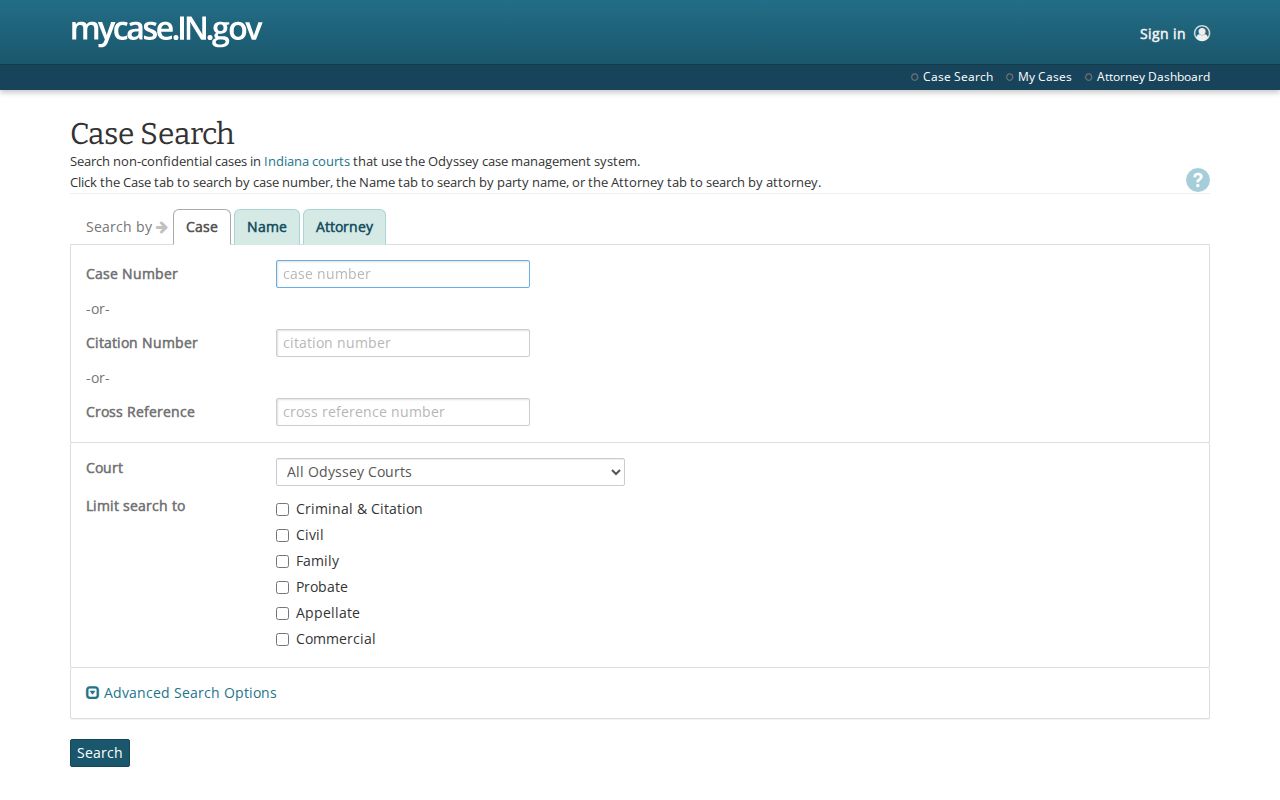
Searches run by case number, citation, cross-reference, party name, or attorney. A last name is required, and a first or middle name narrows the field. Results cap at 1,000. A captcha guards against data mining. Adding an uncertain birth date can knock a case out of the results. Follow the docket text to reach the disposition. The arrest charge may later be reduced, dismissed, or resolved by plea or verdict.
The Indiana MyCase search form provides case, party, and attorney search paths.
What does a roster entry actually document? Booking or custody status, nothing more. MyCase may later show a different charge or a final case outcome, and a private copy can lag behind both.
Indiana Busted Mugshots by Official Source
Match the source to the record you need. These state and county systems share no single search index. Each official source has gaps too. A roster may skip old bookings, MyCase leaves out sealed cases, and a federal locator never shows an Indiana county arrest.
| Source | Record layer | Photo or access note |
|---|---|---|
| County sheriff or jail | Just booked, in custody, and sometimes released records | Photo rules, search windows, and online availability vary by county. |
| IDOC Offender Locator | State-prison custody and offender profiles | The sampled public profile was text-only; request a photo from IDOC if needed. |
| Indiana MyCase | Public court case and disposition records | Not a booking roster or full criminal-history report. |
| BOP Inmate Locator | Federal prison custody from 1982 forward | Search by register number or name filters; no public photo interface. |
| ICE Online Detainee Locator | Immigration detention location | Custody lookup only; not an Indiana criminal disposition or public photo gallery. |
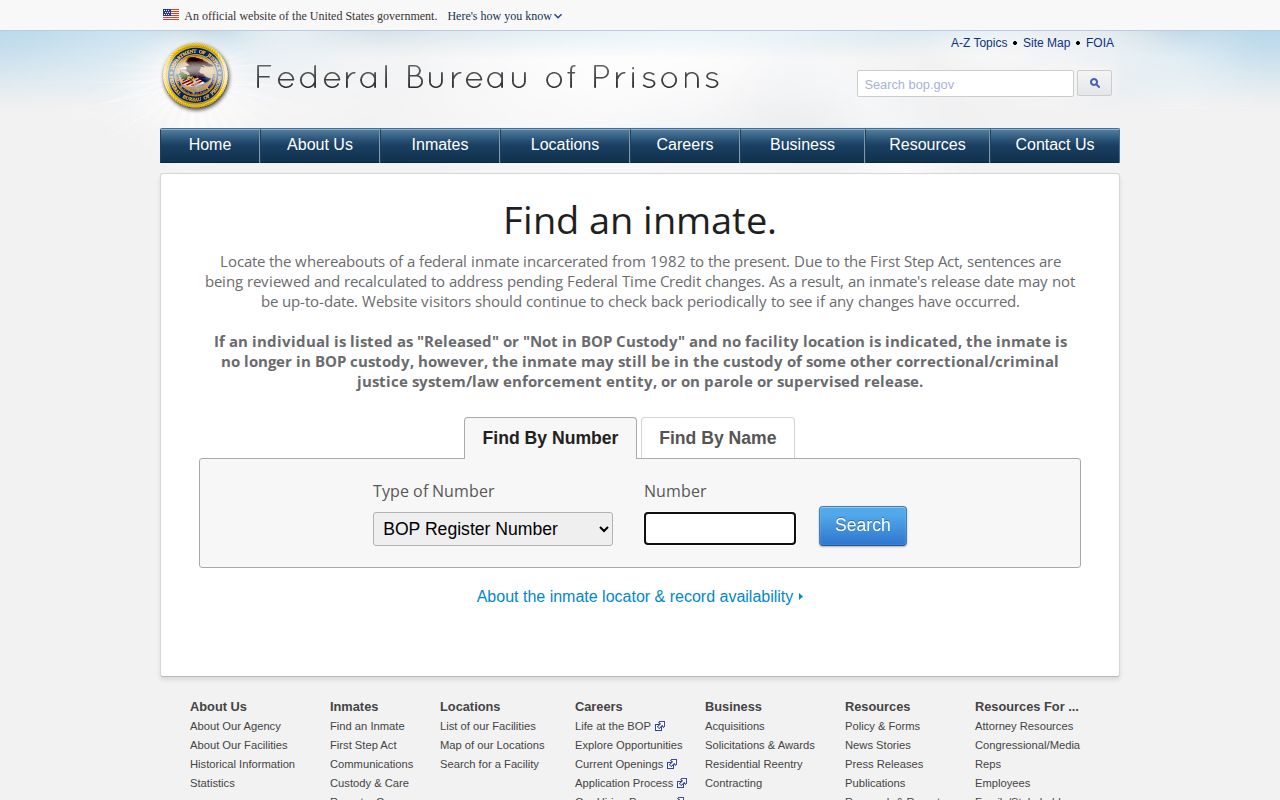
Federal custody runs on separate tools. The BOP locator warns that release dates can lag and that someone outside BOP may sit in another system. Immigration custody uses the ICE Online Detainee Locator System instead, and neither tool replaces the county booking file or a court docket.
The BOP Inmate Locator shows the federal search form and its custody limits.
Indiana County Feeds and Apps
Sheriff apps might offer news, tips, inmate search, or alerts. That is no proof it carries booking photos or a full booking log. Indiana counties have documented separate apps for Dearborn, Boone, Martin, Pike, and Blackford. Each mixes inmate search, news, tips, or wanted notices differently. Check the sheriff's own site for the current app link and what it truly provides.
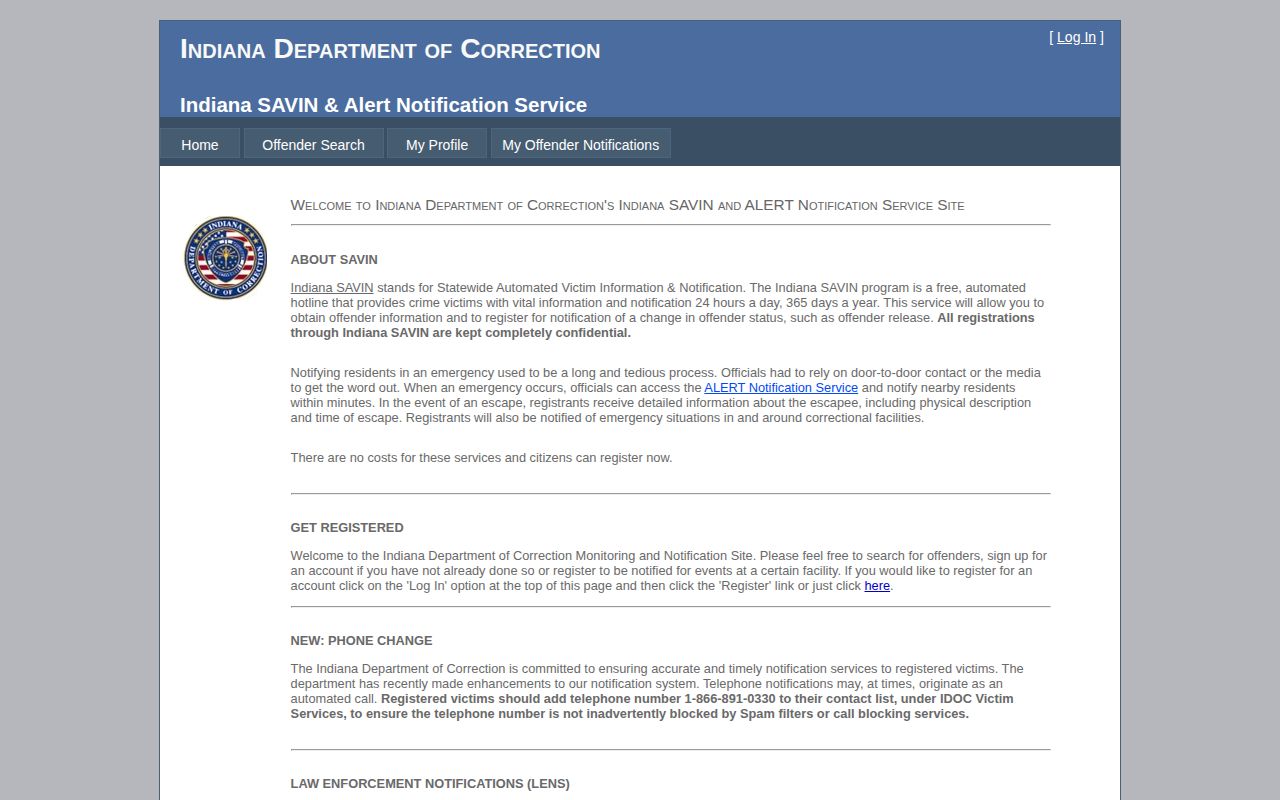
Custody notifications run through Indiana SAVIN and VINELink. IDOC's alert service covers prison escapes and emergencies instead. These tools report a custody change or safety event. An alert covers only the people or events a user selected. They do not replace the county roster, a booking record request, or the docket.
Note: App menus and notification settings change, so confirm current services with the county or state agency offering them.
The Indiana SAVIN landing page shows the state's custody notification service.
Secondary Indiana Arrest Indexes
Start with the official county, state, and court channels every time. The commercial sites below are not Indiana government systems. They skip counties and arrests. They may keep a record after the source page changes. Verify anything you find against the sheriff and the court before relying on it.
BustedNewspaper's Indiana section organizes content by county but is not a state feed. RecentlyBooked's Indiana page covers only the past 30 days, with county coverage that varies. Mugshots.com's Indiana section mixes a historical collection with its own filters. Arrests.org's Indiana pages form another secondary index. Mugshots.zone has no reliable statewide landing page; its documented example is a Washington County removal page. That is not a statewide index. Its local policy should not be generalized.
News coverage is selective, never roster-complete. Central Indiana outlets include FOX59's IndyCrime section, WTHR, WRTV, WISH, and IndyStar. They publish chosen crime and court stories. 21Alive covers northeast Indiana. The Republic reports from the Columbus region. The Carroll County Comet runs a recurring Delphi-area police column. A story may carry a booking photo, an older file image, or no image at all, so read any arrest piece alongside later court updates. No newsroom substitutes for the custodian or docket.
Correction routes on these sites differ. Some want official proof of a changed or restricted record; others have no stable statewide process. No publisher can erase every copy, cached result, or independent record. Lean on the official record first and the publisher's current written policy second. The public-mugshot-law section explains the statewide law and its removal limits.
Note: A correction request to a private publisher cannot change the source agency's record or the court's disposition.
Indiana Warrant Lists at a Glance
Indiana offers several wanted-person tools, and each one answers a different question. IDOC posts a fugitive flyer with photos. The U.S. Marshals Service runs district and national pages for federal fugitives. For custody status, SAVIN and VINELink handle that side. No single statewide site lists every active local warrant.
Checking a specific name? Start with the court or law-enforcement agency in the county where the warrant likely came from. MyCase shows public case activity, though it is not a live warrant roster. Never confront anyone on a wanted list. Pass tips through an agency tip line, and let a lawyer or the court sort out a possible warrant. The Fugitive List page lays out the state's options and safe verification steps.
Indiana Busted Mugshots by County
The 92 county sites here work as routing points. Each one leads to local rosters, request methods, and custody details. A city police arrest often ends with booking at a county jail. So begin with the county that handled intake. Arrested somewhere else? The same name may surface in a different jurisdiction, or it may not be posted yet.
Every county page lists the county seat and a link to the local site. This is a county directory, not a statewide jail list. On each county site, follow the sheriff's official route. Check that page's photo policy, release window, and records custodian. Do that before treating a search result as complete.