
Are Indiana Busted Mugshots Public?
The short answer is: sometimes. Indiana treats a photo held by a public agency as a public record unless an exception applies. That opens the door to inspection or copying. It does not force an agency to post the image online. Under APRA, a custodian may withhold an investigatory record in good faith. Even so, a mugshot is not automatically investigatory.
Different laws cover criminal-history providers and expungement. Neither creates a universal free-removal rule for websites. Everything depends on who holds the image, its legal status, and whether the publisher counts as a covered provider under that chapter.
Plain answer: A booking photo may be available from the public-agency custodian holding it. No single law makes every publisher remove it free or immediately.
Indiana's Busted Photo Rules
Indiana Code chapter 24-4-18 covers defined criminal-history providers, not every publisher on the web. It reaches identifiable arrest, charge, disposition, correctional, and photo information. A covered provider compiles reports or regularly publishes such material online. It must concern at least twelve people each year. Law-enforcement and criminal-justice agencies are excluded. Reporters and journalistic, academic, government, or legal research also fall under exceptions.
The chapter reaches online publication. A site's label does not control whether the rules apply. Section 24-4-18-6 bars a covered provider from knowingly publishing certain information. That covers expunged, restricted, converted-felony, or inaccurate material. Section 24-4-18-7 then addresses an official-record change that happened at least sixty days before delivery. That is an update duty with a knowledge element. It is not a promise that every page changes the moment a court acts.
Check the Indiana Code chapter on criminal-history providers directly. Older online summaries sometimes describe it more broadly than the current text.
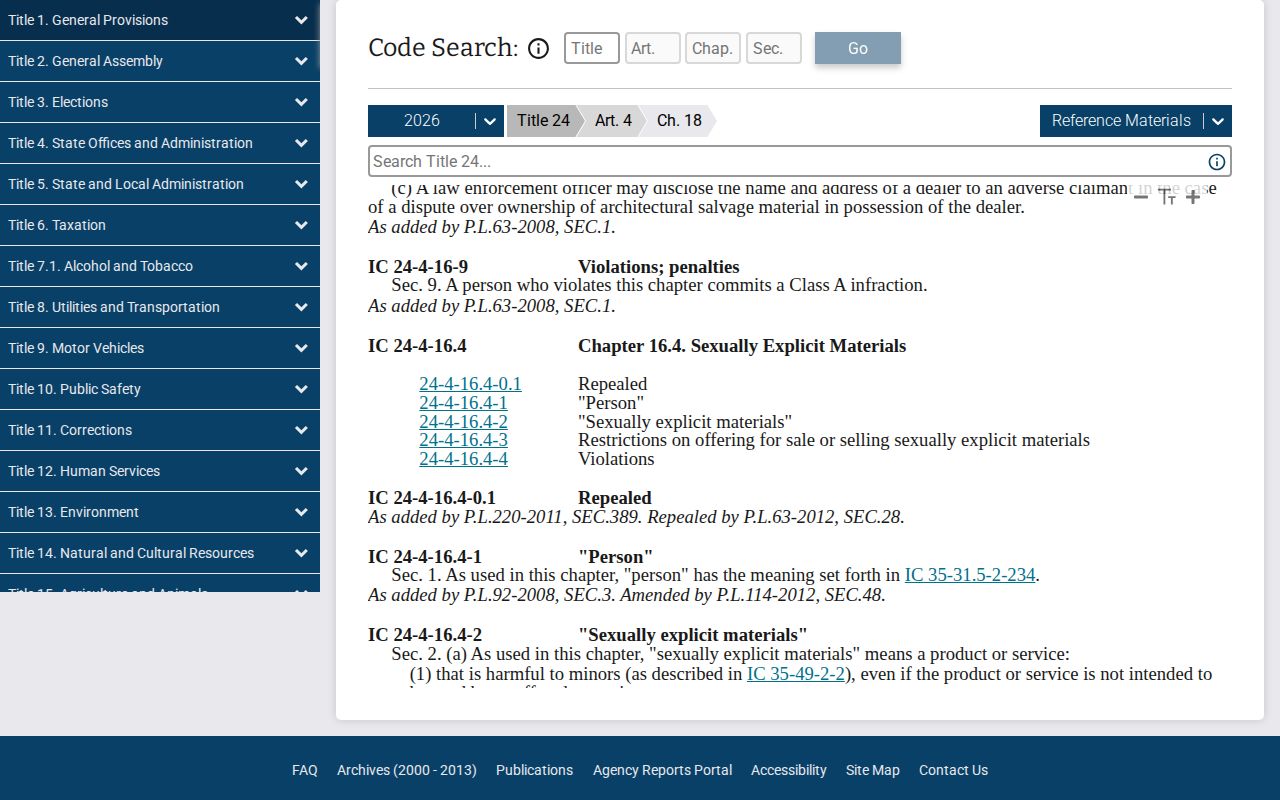
Section 24-4-18-8 treats violations of sections 6 or 7 as deceptive acts under IC 24-5-0.5-4. It also opens a federal-law path. It reaches covered conduct only. It does not apply to every publisher, every request, or guarantee instant deletion.
Indiana Busted Mugshot History
The provider chapter arrived through P.L. 69-2012 and took effect July 1, 2013. A 2021 amendment broadened the definition of online publishers. In 2025, House Bill 1249 proposed new booking-photo requirements, including teeth-and-gums images, but the bill never became law.
Earlier, in Gallagher v. Marion County Victim Advocate, the Court of Appeals treated agency photographs and Bertillon measurements as public records under the law then in force. That ruling is historical context; current APRA exceptions, juvenile rules, and sealing orders still matter. No reported Indiana appellate decision establishes a general removal right under IC 24-4-18.
How Public Records Work
APRA covers records kept by public agencies. It defines photographs as public records. Absent an exception, records must be open for inspection or copying. That duty does not stretch to building a search tool or creating a spreadsheet. It does not require posting every image online either. The official Access to Public Records Act chapter states these rules in full. For practical guidance, turn to the Public Access Counselor. Its guide to public access to warrants and mug shots explains how the photo question fits with APRA.
IC 5-14-3-4(b)(1) lets an agency withhold an investigatory record in good faith. The agency must name a legal basis. A booking image is not automatically investigatory, so ask about the specific photo and custodian. If access is denied, request the cited authority. Public Access Counselor opinion 11-FC-238 illustrates this analysis.
A focused request names the booking or intake photo, the person, a date range, and the likely custodian. Ask about electronic delivery, too. APRA does not require a new record, and an agency cannot hand over an image it does not maintain.
| Question | Where to start | What the source can answer |
|---|---|---|
| Who holds the booking image? | The arresting police department, sheriff, or jail that maintains the intake file | Whether that agency holds the specific photo and whether an exception applies. |
| Was a charge filed? | Indiana MyCase, then the county clerk if the document is not online | Public non-confidential case filings and docket entries, subject to coverage limits. |
| Was the person sentenced to state custody? | Indiana DOC offender search | State-prisoner profiles and the DOC photo layer, not a county booking roster. |
| Did an agency refuse a record? | Ask for its written legal basis, then consult the Public Access Counselor’s guidance | The reason for withholding and possible public-access remedies. |
Juvenile law-enforcement and court records are generally confidential, though narrow exceptions and court orders exist. Victim information gets protection under other laws. An adult roster's photo policy never makes an under-18 person's image public. Do not request or share juvenile booking photos. Each denial should still identify its legal basis.
Find Official Indiana Records
Indiana runs a public court portal called MyCase. It searches non-confidential case files and nothing else. The portal is not a criminal-history database or a booking-photo archive. Sealed and expunged matters stay out of public search, older filings vary, and the system relies on a captcha plus anti-data-mining controls to block bulk access.
The official MyCase search screen greets visitors with a blank form. Case, party-name, and attorney searches are the three options.
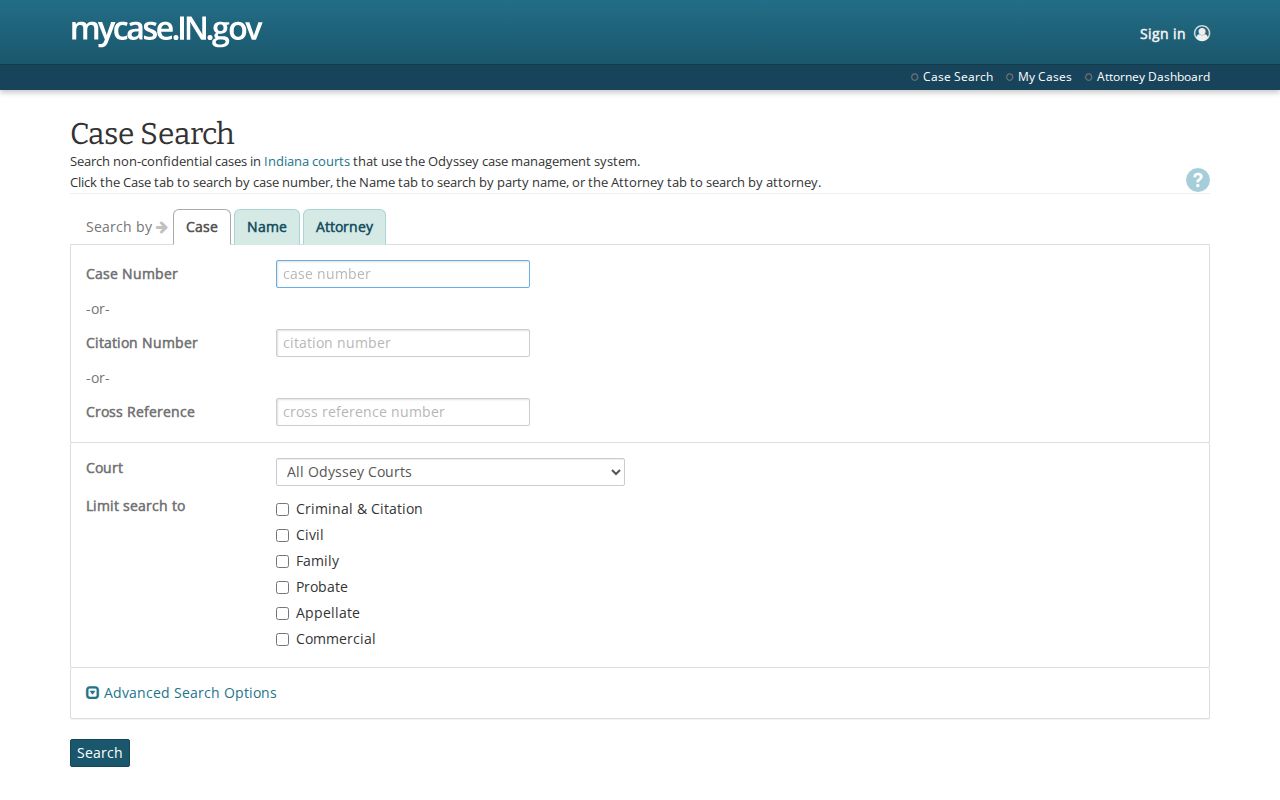
MyCase searches work best with a case, citation, or cross-reference number. Party searches need a last name at minimum. Adding a first or middle name narrows things further. Results top out at 1,000 entries. Birth dates rarely appear there. Filtering by a guessed date can hide the case you want. The docket disposition tells you how the court resolved the matter. If a document is missing online, call the county clerk where the case was heard. The Indiana Judicial Branch public-records page is a routing hub. It links visitors to court records, local clerks, and state services rather than displaying case results itself.
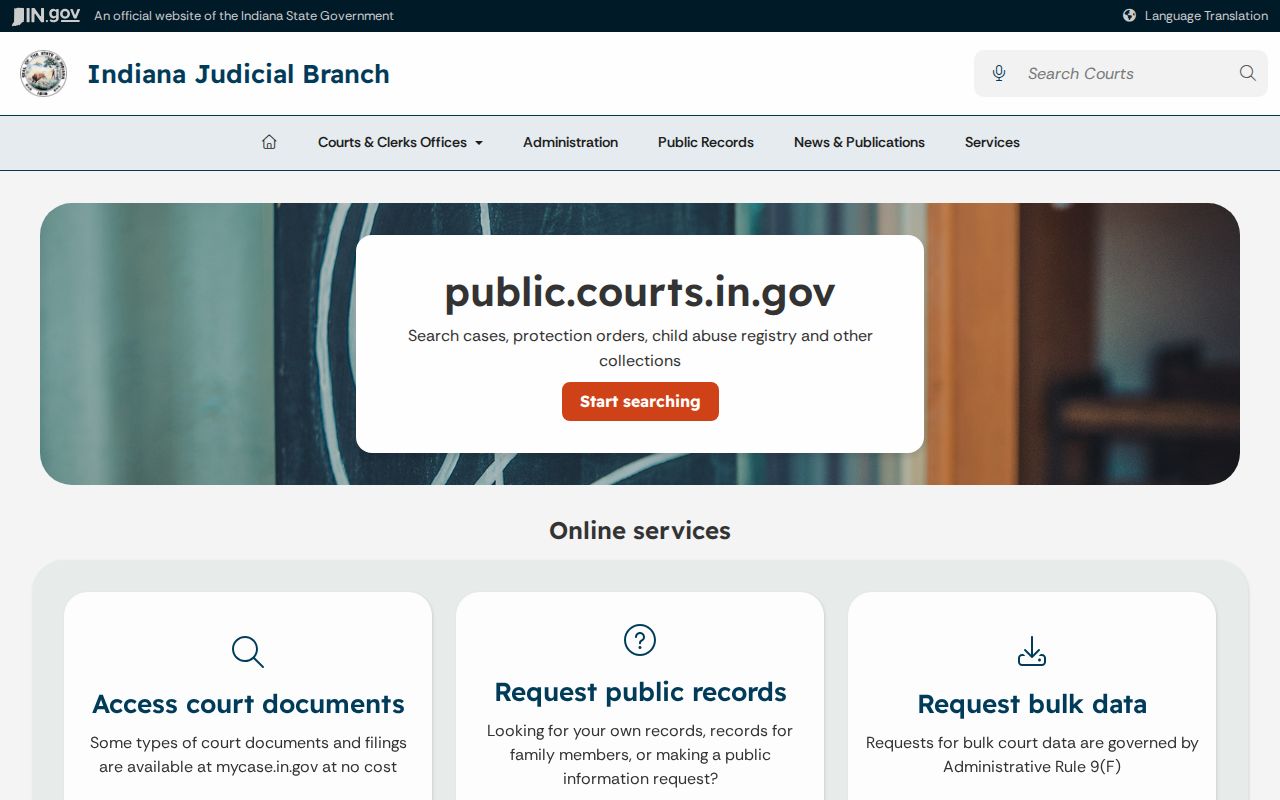
It routes you onward only. The case file itself may still have to come from the local clerk. Booking sources sit in the Indiana busted mugshots statewide guide. Rosters show who is in custody, while MyCase tracks court activity. The two differ because they serve separate purposes.
Correct an Online Busted Mugshot
Start at the official source. Then work outward from there. If a court ordered expungement or another change, get the signed order or docket entry. Confirm the agency record matches it. Ask the agency holding the booking image what its record currently shows. A stale copy on some other site is a publisher's problem. It is not evidence that the court file changed back.
| Stage | Action | Limit |
|---|---|---|
| 1. Confirm the court result | Get the order or official docket entry and note the case number. | A search-result snippet does not replace the court record. |
| 2. Check the agency file | Ask the county custodian to confirm whether the booking record or photo changed. | APRA does not require the agency to create a new record. |
| 3. Contact the publisher | Use the publisher’s current free correction route and provide the relevant order or official update. | Provider rules apply only to covered publishers and qualifying records. |
| 4. Recheck the source | Verify the official record, then request search-engine outdated-content handling if a changed source still appears. | A search engine cannot change a court or agency record. |
Keep copies of every request and every response. Send only what proves the official change. Never mail a full identity packet to a site whose ownership and policy you cannot verify. The Judicial Branch guide and the statute explain the law. A removal form cannot replace that process or promise a photo vanishes from every copy.
Google's tool comes later. The Google Remove Outdated Content tool applies only after the source page has been removed or materially changed. It may refresh a stale result or snippet. It cannot force a publisher to act or erase the source record. Work in order. Official change comes first. Publisher correction comes second. Then request a search-index update for anything still out of date.
Expungement Changes Busted Records
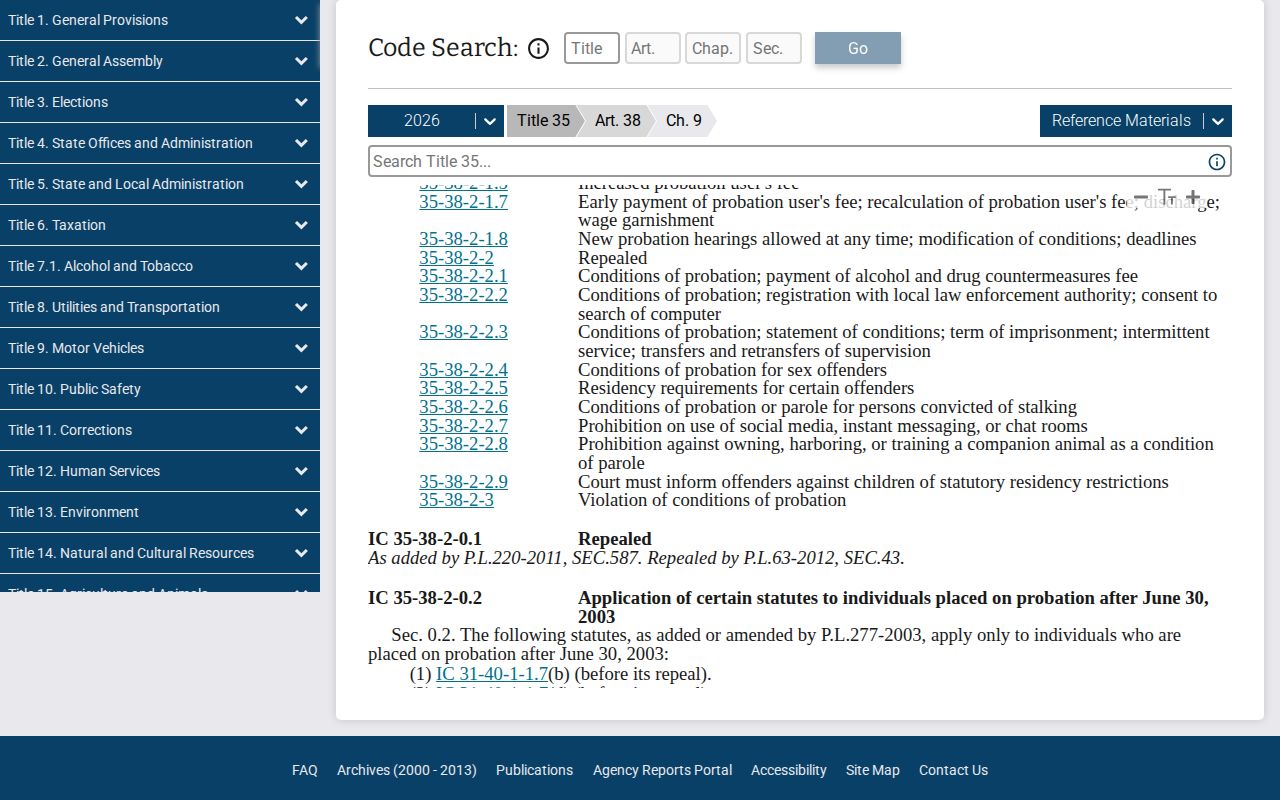
Indiana Code chapter 35-38-9 treats different records in different ways. Since July 1, 2022, some no-conviction outcomes are subject to automatic expungement, including listed situations involving dismissal, no prosecution, acquittal, or a vacated conviction. Other arrest records may require a petition. For an arrest without conviction, the Judicial Branch guide says a petition may be filed no earlier than one year after the later of the arrest, charge, or juvenile allegation, with exceptions such as prosecutor consent to a shorter period.
Conviction categories have separate eligibility rules. The guide describes an eight-year waiting period for eligible Class D or Level 6 felonies unless the prosecutor agrees to a shorter period. For another eligible felony group, the wait is the later of eight years after conviction or three years after sentence completion, again subject to possible prosecutor agreement and the statute’s limits. This is a summary, not a decision about anyone’s eligibility.
The official Indiana Code expungement chapter is shown below. Check the current statutory text and the Judicial Branch expungement guide before taking action.
Some categories keep records public but marked "expunged." The petition and case papers stay confidential. Agencies with database entries must mark the record as expunged under the order and law. That does not wipe every booking image from every site. A separate request is often still needed.
Section 35-38-9-12 ties a provider's publication of an expunged conviction to penalties. Those penalties sit in the criminal-history-provider chapter. That link matters. Still, it operates through the defined provider rules. Confirm the order's scope and ask the original custodian to update its record. Then use a publisher's free correction route.
Note: An expungement order changes access under the law, but copies and search indexes can lag behind the official record.
Why a Photo May Disappear
Indiana's county retention schedule can explain a missing photo. It sets no single photo-retention period. The October 25, 2023 IARA schedule lists PSA 17-39, the Adult Inmate Custody File, for destruction ten years after incarceration ends. PSA 17-40 covers an under-18 custody file. Its destruction comes ten years after termination or seven years after the person turns 18, whichever is later.
Not every booking photo gets its own record series. Ask the county custodian which schedule item applies. Do not assume a retention date controls. A roster can drop an image while the official file remains. A vendor copy can also outlive an official interface change.
The Indiana Archives and Records Administration county public-safety schedule lists other classes too. Daily bulletins and crime reports carry different periods. None of those categories automatically fixes a booking image's lifespan.
Note: Online visibility and legal retention are separate; ask the record custodian which schedule applies to the specific item.
Third-Party Policies Change
An official record can change while a secondary page keeps old text or a photo. Each publisher holds a separate copy. None is the custodian of Indiana's official record. Policies and forms at these sites shift over time, so read the live publisher page before sending anything.
| Secondary source | What the research found | Limit |
|---|---|---|
| RecentlyBooked | Its policy describes a free correction or removal route for incorrect, outdated, expunged, sealed, or restricted records. | The request has documentation requirements; its state page is not an official custody feed. |
| Busted Newspaper | The publisher lists a free request route for corrections or legally supported removal. | Confirm current submission rules and verify the court result separately. |
| Mugshots.com | Its policy describes a free process tied to documented official changes. | The page may be updated to show a disposition rather than removed. |
| Arrests.org Indiana | No stable Indiana-wide free opt-out policy was verified. | Do not assume a statewide removal promise; use only a current route shown on the exact listing. |
| Mugshots.zone example | A Washington County page has a documented correction form. | No reliable statewide Indiana index was verified, so this county page is not a state policy. |
A third-party page listing many counties proves little. Its size and date range do not guarantee full coverage of Indiana counties. Treat those pages as a starting point. They are not an official answer. A real correction still takes the case disposition and a check at the source itself.
A Mugshot Is Not a Verdict
Busted is a search term, nothing more. It is not a legal finding. A booking photo simply documents an arrest event at a jail. Dismissals, acquittals, vacated convictions, expungement orders, and newer docket entries carry far more weight than an old photo caption.
Record-use notice: This is public-record information. It is not a consumer report under the Fair Credit Reporting Act and must not be used for any purpose that law regulates.
Never build claims from a name match alone. The official court record comes first. Ask the agency that holds the booking file as well. If that record changes, keep the dated order and follow the publisher's current correction route for any separate copy.