
Indiana Mugshot Archives
State files and county bookings travel on separate tracks in Indiana. Prison records move from the Indiana Department of Correction to the Indiana Archives and Records Administration. That transfer happens ten years after a person's release or death. Inmates still in custody stay in the current offender system instead. That rule makes IARA a historical source. It is not a feed of recent county arrests. The IARA Department of Correction holdings page explains the ten-year transfer point. It also names the collections open for research.
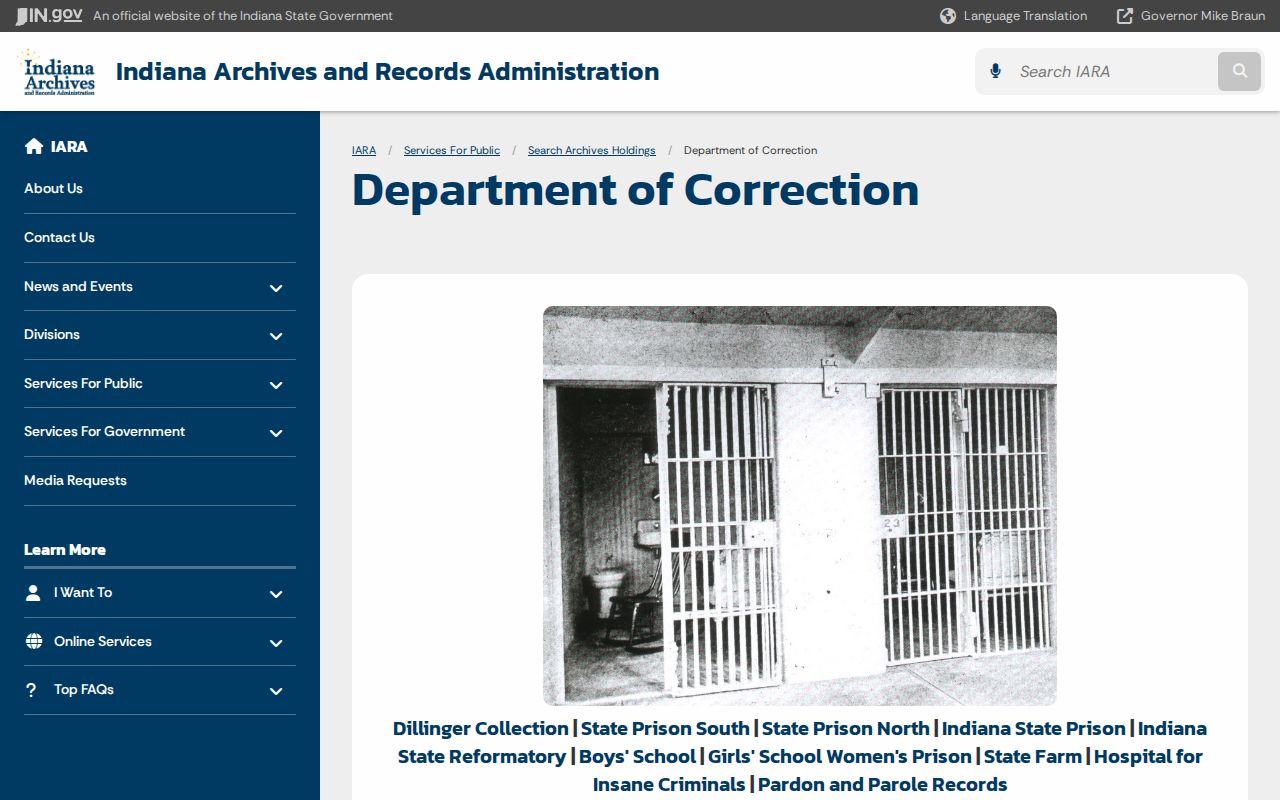
The collection list points a search toward a specific institution and record series. That detail helps narrow a request before anyone contacts the Archives. County jail material follows a different route. Most counties keep their own booking records unless the papers get transferred. Old county photos start with the sheriff or jail. Age alone tells you nothing about where a file ended up. A record may still sit at the county. It may have been destroyed under an approved schedule. Or it may simply be hard to locate now. Only the agency that held it can confirm which case applies.
Indiana Prison Collections
IARA's correctional holdings reach across many institutions and eras. The table keeps things honest by separating what the holdings page actually describes. An index entry, a surviving file, an image, and online access are four different things. A collection can exist regardless. One person's page may never have been scanned.
| Collection | Era or scope | What the holdings describe |
|---|---|---|
| State Prison South | 1822-1897 | Descriptive-book index and a corresponding photo album where available. |
| State Prison North / Michigan City | Index after 1897 | Descriptive books, commitment papers, an index, and related inmate material. |
| Indiana State Prison | Record books, 1897-1966 | A large mugshot collection, especially among the first 9,000 entries, plus prisoner, warden, and commitment packets, an index, and a life-prisoner photo album. |
| Indiana State Reformatory | Index, 1897-1923 | Later records are handled through the broader holdings and catalog. |
| Boys’ School | 1867-1937 online material | Some later material is not online. |
| Girls’ School | 1873-1935 online material | Names from 1936-1984 are withheld online for confidentiality, while early photos and packets exist. |
| Women’s Prison | Record books, 1873-1969 | Occasional photos, admission cards, and packets. |
| State Farm | Reports, 1915-1931 | Sparse inmate packets and monthly admission and discharge reports. |
| Hospital for Insane Criminals; Pardon and Parole | Additional correctional series | May support institutional history; these are not modern booking rosters. |
Begin with the institution that matches the person's custody history, not just an arrest date. The holdings page and Research Indiana can show whether a name sits in an index, whether a later series needs a catalog search, and whether a collection has material online. Neither one proves a photo survived. They answer narrower questions than that. Note: Collection dates describe the holdings series as a whole, not the date of every photo or the digitization status of any single file.
Indiana Archive Index
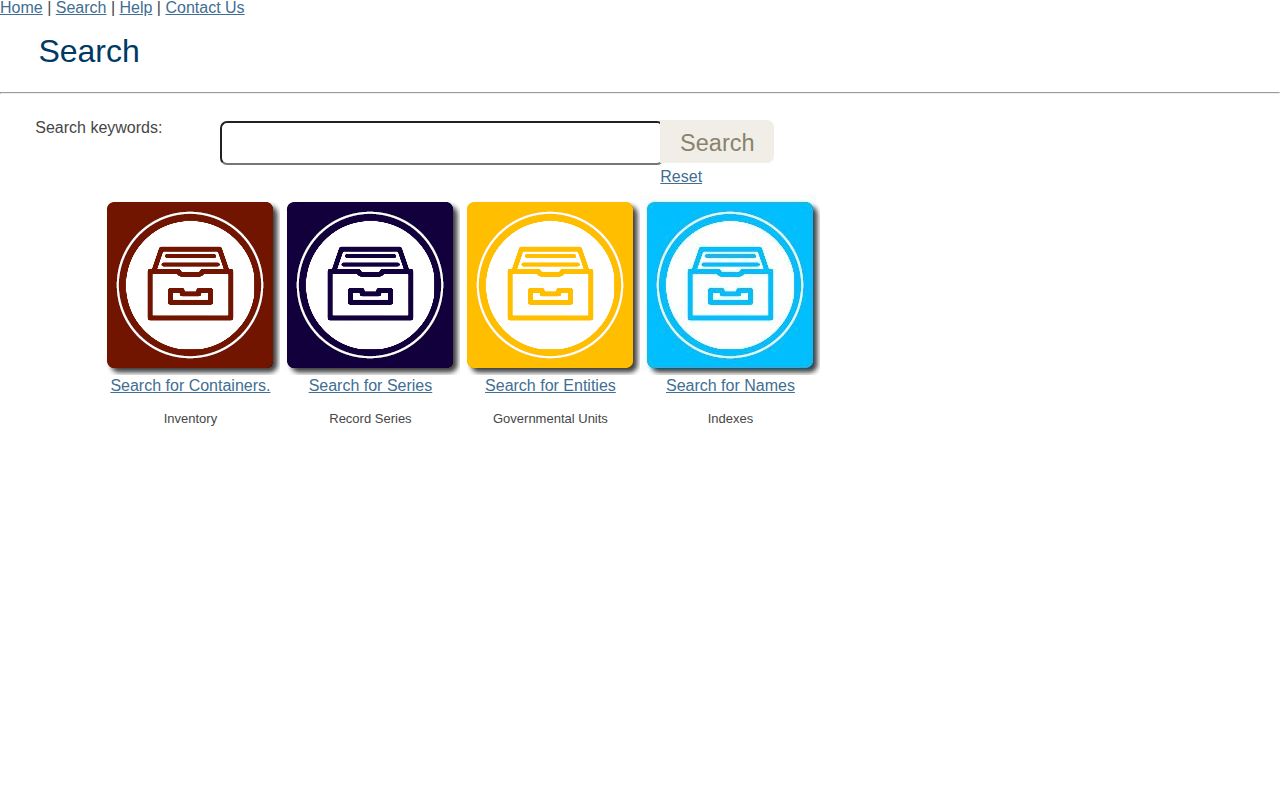
The Research Indiana index searches many IARA records and is a useful first step for names tied to state institutions. Search results are finding aids, not a promise that every page or image is scanned. A name may lead to a descriptive book, a record series, or a physical packet that needs a separate request. A missing result also does not prove that no record exists, especially when the collection is indexed only in part.
The Research Indiana search interface gives a starting point for archive work without displaying a booking-photo collection.
An index hit is one checkpoint. A physical packet, a photograph, a confidentiality review, and permission to reproduce an image are separate checkpoints along the way. The IARA Dillinger Collection description shows what a rich file can hold. It covers front and profile identification cards. Reverse-side details add name, age, crime, sentence, criminal history, and institutional history. IARA cautions that state-prison and reformatory images are state property. Posting or publishing them without permission is not allowed. A scan fee buys a copy, not publication rights. An archive search can identify a record for study, but the image rules still apply.
Indiana County Photo Retention
Want an old county booking photo? Ask the county first. Find out which records series covers the adult or under-18 custody file. The IARA county public-safety schedule lets agencies destroy certain records once the stated period passes. It cannot tell you that a particular county destroyed a specific photo, or shipped it to the State Archives.
The IARA county public-safety retention schedule spells out the categories. Item PSA 17-39 covers the adult custody file. Destruction is allowed ten years after incarceration ends. PSA 17-40 governs the under-18 custody file, with destruction permitted at the later of two dates: ten years after incarceration terminates, or seven years after the person turns 18. These rules apply to the listed file categories, not to every booking photograph as a class.
Next, take the questions to a person. Ask the sheriff, the records custodian, or IARA which schedule item covered the specific booking image, whether the file survives, and whether it moved. County jail records generally stay with the county unless transferred. The IARA Department of Correction page is not a statewide archive of modern county jail photos. A state-prison transfer rule, then, has no bearing on a county booking.
State-prison material runs on a different clock. There, the ten-year IDOC transfer point also hinges on release or death. Current inmates remain an IDOC matter. The two timelines answer different questions and sit with different custodians. Identify the custody layer before you request an old photo.
Note: A retention schedule only permits destruction within a category; the custodian alone can confirm whether a specific image survives or was transferred.
Indiana Archive Requests
Search the index before writing. Give IARA details that distinguish the person. Staff ask for a name plus, when known, an approximate date of birth, institution, inmate or DOC number, date range, and collection or index reference. State whether the request is for a scan or a certified copy. Those specifics help staff locate the right record group. They do not guarantee the item survives or is open for release.
- Search Research Indiana by the full name and likely institution. Save the result title, collection reference, and any record or image identifier.
- Write to arc@iara.in.gov with the name, approximate date of birth if known, institution, inmate or DOC number, and date range.
- Identify the index entry or collection, and specify whether a scan or certified copy is wanted. Ask about confidentiality and permission to reproduce any image.
- Wait for the Archives to confirm availability and provide payment and shipping instructions. No turnaround is promised in the research material.
Public contact runs through Indiana State Archives, 6440 E. 30th Street, Indianapolis, IN 46219, telephone 317-591-5222. Check current public access arrangements before any visit. Some requests end with an index citation only. Others return a packet with no photograph inside. Treat each outcome as its own answer rather than proof the record was never made.
Indiana Archive Fees
IARA's fee structure was approved on September 25, 2024. Charges vary by copy type. Research time matters too. The official State Archives fee schedule and the IARA fee page separate routine copies, scans, and staff research, which helps a requester match the service to the question. Payment and shipping instructions come after the Archives confirms what it can supply.
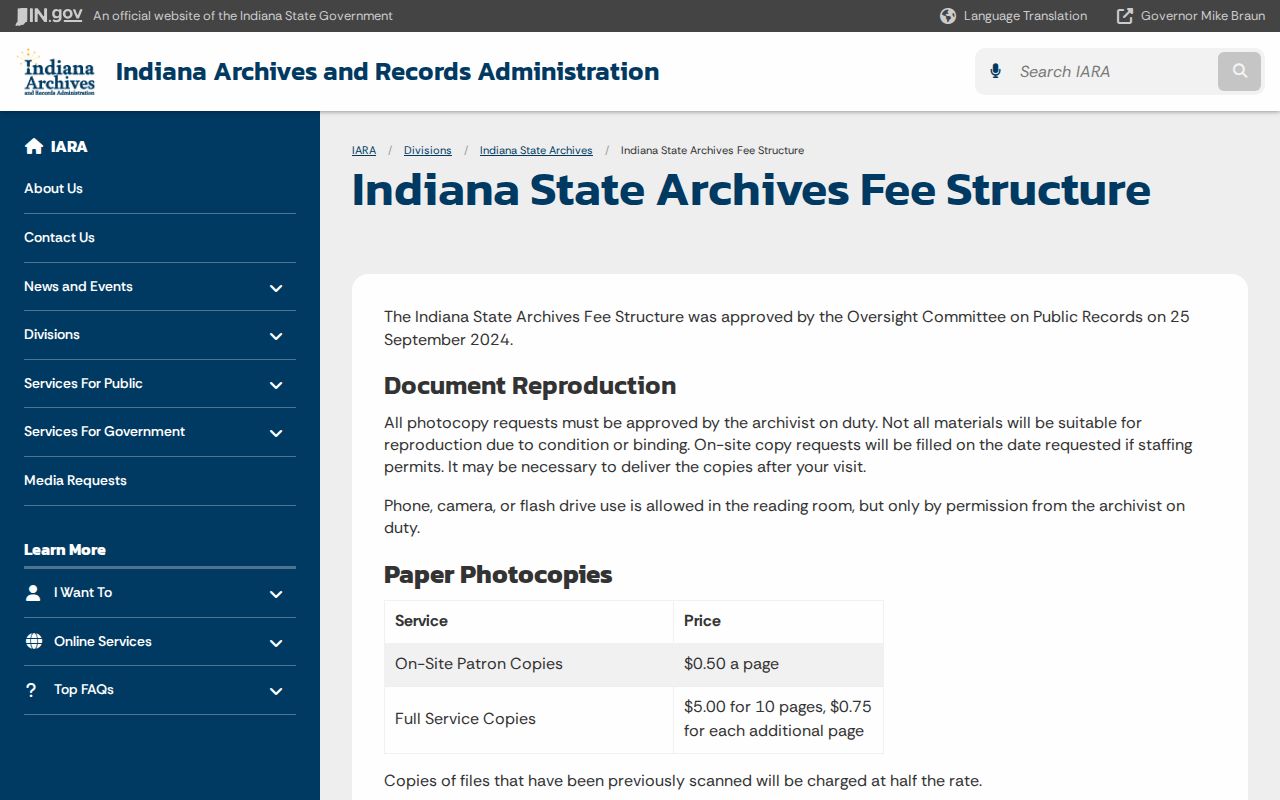
Copy charges settle neither access limits nor image-reproduction rights. Confirm both before any use beyond private research.
| Request type | Published charge |
|---|---|
| On-site copies | $0.50 per page |
| Full-service copies | $5 for the first 10 pages, then $0.75 for each additional page |
| Existing scans | $1 |
| Image scans below 400 ppi | $5 |
| Image scans above 400 ppi | $10 |
| Research for Indiana residents | First hour, then $15 for each half-hour increment |
| Research for out-of-state requesters | $15 per half-hour, with a minimum charge |
Research charges are separate from copy fees. A staff search may show where a record sits, and the later copy request carries its own price. Neither step is guaranteed. The posted schedule does not promise that a search will find a photograph or that a requested image can be reproduced.
Indiana Archives vs Recent Bookings
Old and new records take different paths. Recent jail searches start with the holding county. The Indiana County Directory routes a request to the right locality. For current rosters and feeds, the statewide booking-record overview explains that landscape. Older state correctional material may be described in IARA holdings. An old county booking photo may stay local. The Indiana Historical Bureau's historical marker record adds context for the Crown Point and Dillinger history. A marker, though, is not an inmate file, booking record, or court disposition.
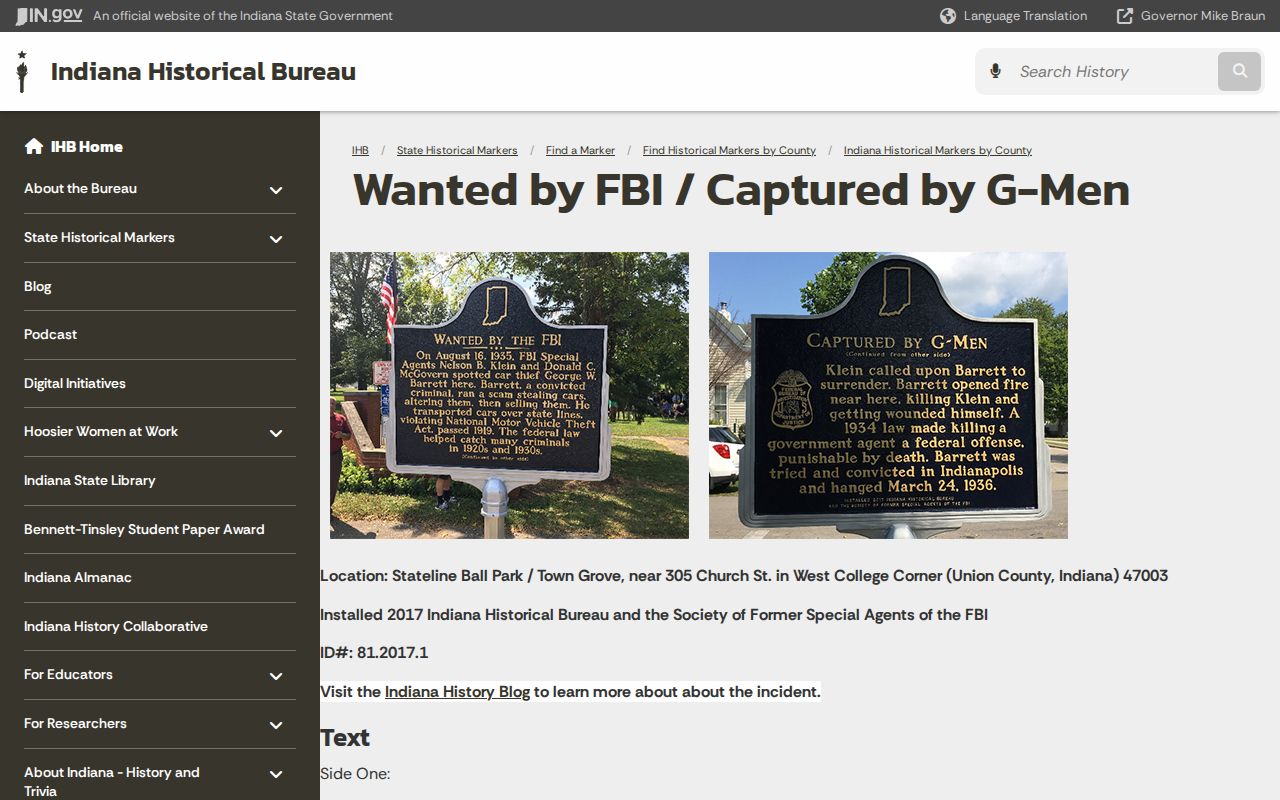
Historical context can point toward a record trail. The archive or court file remains the source for the record itself.
A blank result is not the end. Ask who the custodian was and which schedule applied. The miss may mean the record was never digitized, is held locally, is restricted, or did not survive. Indiana's archive collections preserve substantial correctional history. Even so, they are no substitute for a county's current jail roster.
Note: A marker can add historical context, but it never replaces a county, correctional, or court record.